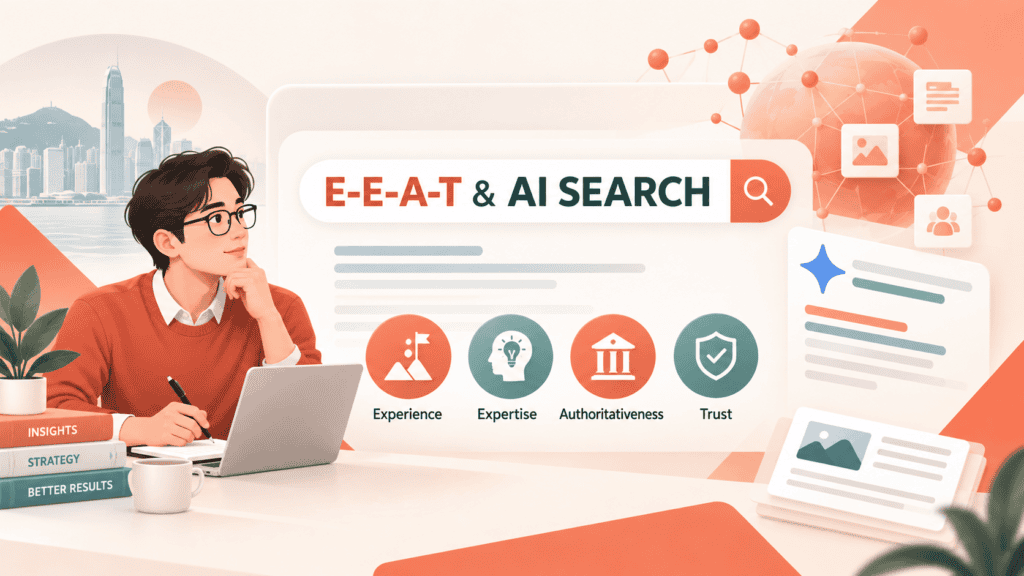
Google’s quality guidance has changed substantially since this article was first published in 2020. E‑A‑T became E‑E‑A‑T, adding Experience, while AI Overviews and other generative search features have made clear, trustworthy and original content even more important.
Table of Contents
ToggleThis guide explains what E‑E‑A‑T means in 2026, what it does—and does not—do for rankings, and how organisations in Hong Kong and across Asia can apply it to SEO, digital marketing and AI-assisted content.
What does E‑E‑A‑T mean?
- Experience: first-hand involvement with the subject, product, service or situation.
- Expertise: relevant knowledge or skill demonstrated accurately and at the right depth.
- Authoritativeness: recognition of the creator or organisation as a dependable source in its field.
- Trustworthiness: accuracy, transparency, safety and confidence in the creator, content and website.
Google says trust is the most important part; the other elements contribute to it. E‑E‑A‑T is not a single ranking factor. Instead, Google’s systems use multiple signals that can help identify content demonstrating these qualities. The concept is especially important for subjects that may affect health, finances, safety or well-being.
Why E‑E‑A‑T matters for SEO and AI search
Google’s 2026 guidance says the foundations of SEO also support visibility in generative features such as AI Overviews and AI Mode. Crawlability, useful original information, strong page experience and clear sources remain central. Google also cautions against treating AEO or GEO as a collection of shortcuts: creating many near-duplicate pages or content designed primarily to manipulate AI responses can violate its spam policies.
For brands, the practical lesson is simple: publish material that a real audience would find useful even if search engines did not exist. Make the organisation, people and evidence behind the advice easy to verify.
A practical E‑E‑A‑T framework for brands
1. Show first-hand experience
Replace generic summaries with details that only direct experience can provide. Use original examples, campaign lessons, screenshots, workshop observations, process notes and results that can be supported. A case study should explain the challenge, approach and learning—not merely name a client.
2. Make expertise visible
Add accurate author names, useful biographies and links to relevant professional profiles. Explain why the author is qualified to cover the subject. For specialist or high-stakes topics, use expert review and show when the material was last checked.
3. Support claims with evidence
Link to primary sources, define the scope of statistics and remove claims that cannot be verified. Distinguish facts from opinions and label examples clearly. When information changes, update the relevant section rather than changing the date alone.
4. Strengthen business trust signals
Keep the company name, address, contact information and service descriptions consistent across the website and credible external profiles. Make privacy, terms and customer-support information easy to find. Use structured data only when it accurately represents visible content.
5. Explain responsible use of AI
Google does not prohibit AI-assisted content, but mass-producing pages without added value may be treated as scaled content abuse. Human review should check factual accuracy, relevance, originality, tone and sources. When readers would reasonably ask how something was produced, explain the role of automation or AI.
The “Who, How and Why” content test
- Who created it? Identify the author or responsible organisation and show relevant background.
- How was it created? Describe research, testing, review or AI assistance when that context helps readers assess the work.
- Why was it created? The primary purpose should be helping an intended audience, not attracting visits through manufactured search variations.
This test is useful beyond traditional search. Clear authorship, direct answers, consistent entity information and well-supported claims also make content easier for people and AI systems to interpret and cite.
E‑E‑A‑T checklist for a marketing page
- One clear topic and audience need
- An identifiable author or responsible organisation
- Original experience, analysis or examples
- Primary sources for important factual claims
- A visible review or update date when freshness matters
- Consistent company and contact details
- Descriptive headings, links and image alt text
- Relevant internal links that help readers continue their journey
- No exaggerated claims or invented credentials
- Human review of AI-assisted material
What marketers should do next
Start with the pages most closely connected to your expertise and commercial goals. Improve those pages with original evidence, clearer authorship and useful answers before expanding into additional topics or locations. This approach supports sustainable SEO and avoids thin “GEO” pages created only to match search variations.
Explore the Social Stand AI and Digital Marketing Knowledge Hub, our guide to AI for marketers, or corporate training in Hong Kong.
Build trustworthy digital capability
Social Stand helps organisations strengthen digital strategy, responsible AI adoption, storytelling and social media capability through consulting and customised training.
Primary references: Google: Creating helpful, reliable, people-first content; Google: Guidance on generative AI content; Google: Optimising for generative AI features.
SOCIAL STAND BRIEFING
Practical AI & Digital Marketing Insights
Get useful ideas on AI, digital marketing, social media and brand storytelling for leaders and teams across Hong Kong and Asia.