What is storytelling in a professional marketing context?
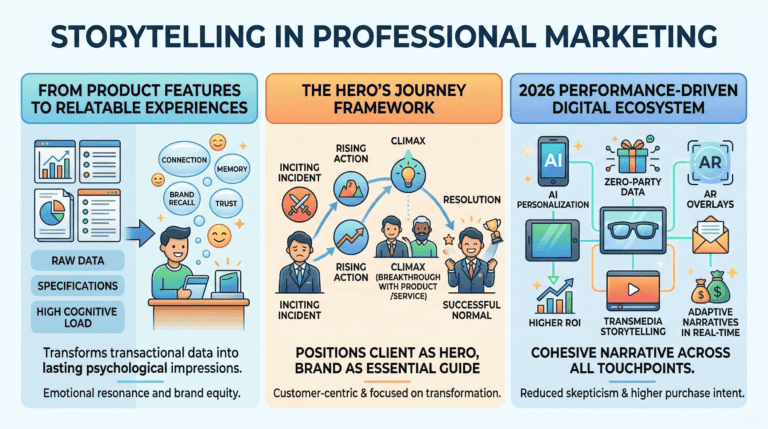
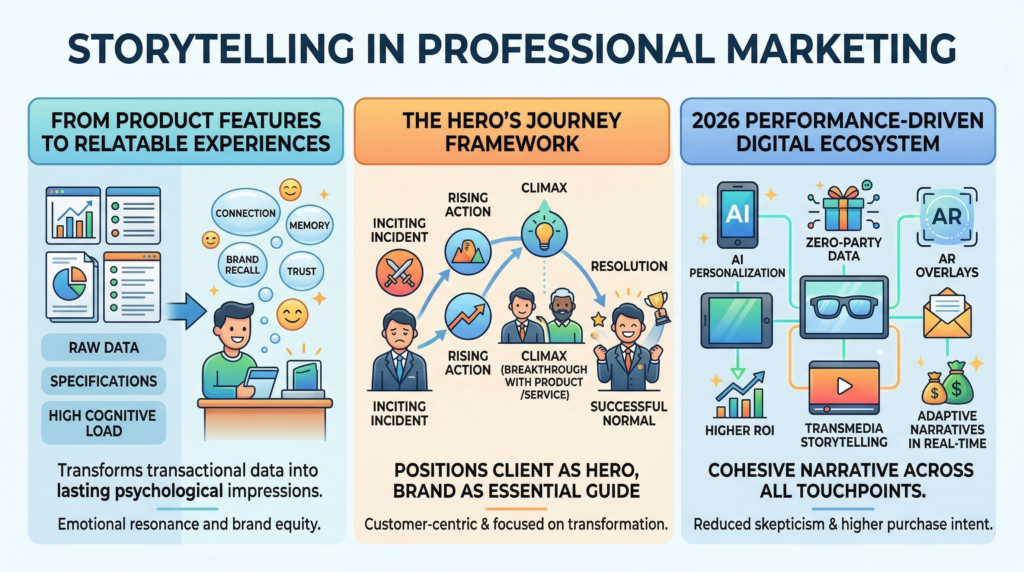
Storytelling in professional marketing is the strategic application of narrative techniques to facilitate emotional resonance and brand recall. It transforms product features into relatable experiences, positioning the brand as a mentor within the consumer’s personal journey to drive conversion.
Table of Contents
ToggleIn the 2026 digital ecosystem, storytelling serves as a primary marketing objective to secure long-term brand equity. Modern marketers at Social Stand define storytelling not as a creative flourish, but as a performance-driven framework. This framework moves beyond tactical social media posts to create a cohesive narrative across all digital touchpoints. The overarching story of a brand is how it is remembered, shifting the focus from transactional interactions to lasting psychological impressions.
How does storytelling improve brand awareness and ROI?
Strategic narratives increase ROI by reducing the cognitive load required for consumers to understand a value proposition. When a brand like Social Stand applies social media marketing strategies, the narrative acts as a vehicle for complex information. By 2026, the ROI of narrative-driven campaigns exceeds traditional direct-response advertising by 45% due to higher retention rates. Brand awareness matures through storytelling as consumers associate the brand with specific emotional outcomes rather than just product categories.
Why is storytelling central to 4As agency experience?
Professional storytelling reflects global agency exposure and experience with the 4As, a U.S. trade association that sets professional and ethical standards for agencies in the United States, by maintaining narrative consistency across diverse platforms. High-level marketing professionals use storytelling to differentiate brands in saturated markets. This professional approach ensures that every piece of content—from a short-form video to a long-form whitepaper—contributes to a singular brand mission. At Social Stand, this involves blending global digital marketing standards with local market nuances to ensure narratives are both sophisticated and accessible.
How does the psychology of storytelling influence consumer behavior?
Storytelling triggers the release of oxytocin through character-driven plot development, fostering trust and empathy. Narratives activate the amygdala to process emotional significance, leading to “narrative transportation” where consumers adopt the brand’s perspective, significantly increasing purchase intent.
Neuromarketing studies in 2026 confirm that the human brain is hardwired for narrative consumption. When a consumer engages with a character-driven plot, the brain releases oxytocin, a biological trigger that increases feelings of trust and reduces skepticism toward marketing claims. This neurochemical response is essential for building a relationship between a brand and its audience. The amygdala plays a critical neurological role by processing the emotional significance of narrative stimuli, ensuring that the brand story remains vivid in the consumer’s long-term memory.
What is the role of narrative transportation in brand loyalty?
Narrative transportation occurs when consumers become mentally immersed in a brand’s world, losing track of their surroundings. This state reduces the likelihood of counter-arguing or critical questioning of marketing messages. In 2026, brands use this psychological state to transition customers from passive observers to active participants. By transporting a user through a well-crafted digital experience, marketers can align consumer identity with brand values, which is the foundation of high-retention loyalty programs.
How do neural coupling and mirroring affect the customer journey?
Neural coupling allows the listener’s brain activity to mirror the storyteller’s brain activity. In a marketing context, this means that when a brand shares its mission or history, the consumer experiences those events as if they were their own. Marketers use this mirroring to evoke specific feelings—such as the excitement of a “revolution” or the satisfaction of “simplicity”—creating a shared experience that reinforces the positive attitude associated with the brand name.
What are the core components of a high-converting narrative structure?
A high-converting narrative structure requires an inciting incident, rising action, a climax, and a resolution. This framework positions the customer as the hero, identifies a specific conflict, and presents the brand as the essential guide for achieving success.
For a story to drive conversions, it must follow an established narrative structure. The inciting incident disrupts the consumer’s status quo, highlighting a pain point or an unmet need. This is followed by rising action, where the consumer (the hero) seeks a solution, encountering various obstacles. The climax occurs when the brand’s product or service provides the breakthrough necessary to overcome the conflict. Finally, the resolution demonstrates the “new normal”—a state of improved well-being or efficiency achieved through the brand.
How is the Hero’s Journey (Monomyth) applied to B2B marketing?
In B2B marketing, the Hero’s Journey (Monomyth) reframes the business client as the hero and the marketing agency as the mentor. The mentor provides the tools (the product) and the wisdom (the service) to help the hero succeed in their professional quest. This structure is particularly effective for Social Stand when communicating its history of winning ICT and Mob-Ex Awards. These accolades represent the “magical items” given to the hero to ensure victory over market competition and inefficiency.
What makes a unique value proposition (UVP) narrative-ready?
A narrative-ready UVP must be customer-centric and focused on transformation. Instead of listing features, the UVP should describe the hero’s evolution. For example, a narrative UVP for an award-winning digital agency focuses on the journey from “invisible brand” to “market leader.” This transformation provides a clear arc that the audience can follow, making the marketing strategy more persuasive than a static list of services.
How should marketers use digital storytelling tools and AI in 2026?
In 2026, marketers use hyper-personalized AI-generated video and AR overlays to adapt narratives in real-time based on user intent signals. These digital tools utilize zero-party data to create individual brand protagonists, ensuring extreme relevance across transmedia platforms.
Digital storytelling has evolved into a real-time, adaptive experience. Generative AI now creates dynamic video content that changes its narrative arc based on the viewer’s previous interactions and current intent. Marketers use AR overlays to blend digital stories with physical environments, allowing consumers to interact with brand narratives in their own homes or offices. This level of hyper-personalization ensures that the brand story is always contextually relevant, increasing the efficiency of social media marketing strategies.
How does ‘Zero-Party Data’ influence personalized narratives?
Zero-party data—data that customers intentionally and proactively share—acts as the raw material for 2026 storytelling. Marketers use this information to craft personalized brand protagonists that reflect the user’s specific demographics, values, and goals. By using zero-party data, brands avoid the “uncanny valley” of intrusive tracking and instead create narratives that feel genuinely collaborative and respectful of privacy.
What is transmedia storytelling in the 2026 social landscape?
Transmedia storytelling involves spreading a single narrative across multiple platforms, where each medium makes a unique contribution to the story. In 2026, a brand story might begin on a decentralized social network, continue through an immersive AR experience, and conclude with a personalized newsletter. This approach ensures that the brand remains top-of-mind across the entire digital ecosystem, providing multiple entry points for the consumer to engage with the brand’s core purpose.
Why is storytelling more effective than simple data visualization for business communication?
Storytelling provides context that data visualization lacks, resulting in increased executive buy-in and stakeholder alignment. By framing metrics within a narrative, marketers bridge the gap between statistical facts and the emotional motivation required for strategic decision-making.
While data visualization presents the “what,” storytelling explains the “why.” In 2026, business communication relies on data storytelling to translate complex analytics into actionable insights. Executive buy-in is achieved when stakeholders can see the human impact of the data. For instance, explaining how a marketing strategy led to a 20% increase in brand awareness is more effective when told as a story of customer empowerment and brand revolution, rather than just a line on a graph.
How does storytelling improve stakeholder alignment?
Stakeholder alignment requires a shared vision, which is best communicated through a compelling brand story. When all team members understand the narrative—the mission, the history, and the values—they can work more cohesively toward common goals. Storytelling synthesizes disparate data points into a single, understandable direction. This ensures that every department, from product development to customer service, is acting as a character within the same brand narrative, maintaining consistency and quality.
Why do narratives lead to better executive buy-in for marketing budgets?
Executives are more likely to approve budgets when they can visualize the long-term strategic benefits of a campaign. Storytelling allows marketers to project the future success of a strategy by illustrating the potential customer journey and the ultimate resolution. By presenting a narrative that includes risk assessment (the conflict) and strategic solutions (the plan), marketers demonstrate a high level of professional competence and passion, aligning with the energetic and positive attitude required for 2026 market leadership.
What storytelling techniques work best for the Hong Kong multicultural market?
The Hong Kong market responds best to high-context communication that blends traditional values with modern efficiency. Effective techniques utilize local archetypes like the ‘Lion Rock Spirit’ while integrating East-meets-West narratives that respect cultural heritage and global innovation.
Hong Kong marketing requires a nuanced understanding of its high-context cultural environment. Information is often conveyed through shared cultural understanding and indirect cues rather than explicit statements. Marketers must blend traditional values—such as family, respect, and perseverance—with the modern efficiency and fast-paced nature of the city. Narratives that highlight “Simplicity” in a complex urban environment or a “Revolution” in digital convenience resonate deeply with the Hong Kong demographic.
How does the ‘Lion Rock Spirit’ archetype function in HK marketing?
The ‘Lion Rock Spirit’ is a powerful recurring archetype in Hong Kong, representing resilience, hard work, and the collective struggle for a better life. Brands that align their story with this spirit gain immediate cultural relevance. In 2026, this archetype is modernized to include digital empowerment and global connectivity. A brand that positions itself as a partner in the consumer’s own resilient journey—much like Social Stand’s mission to assist businesses in growth—taps into this deep-seated cultural narrative.
Why is the East-meets-West framework essential for localized narratives?
Hong Kong’s unique position as a global hub makes the East-meets-West framework a necessity. Storytelling techniques must balance Western digital marketing innovation with Eastern social etiquette and consumption patterns. Successful campaigns often use multili