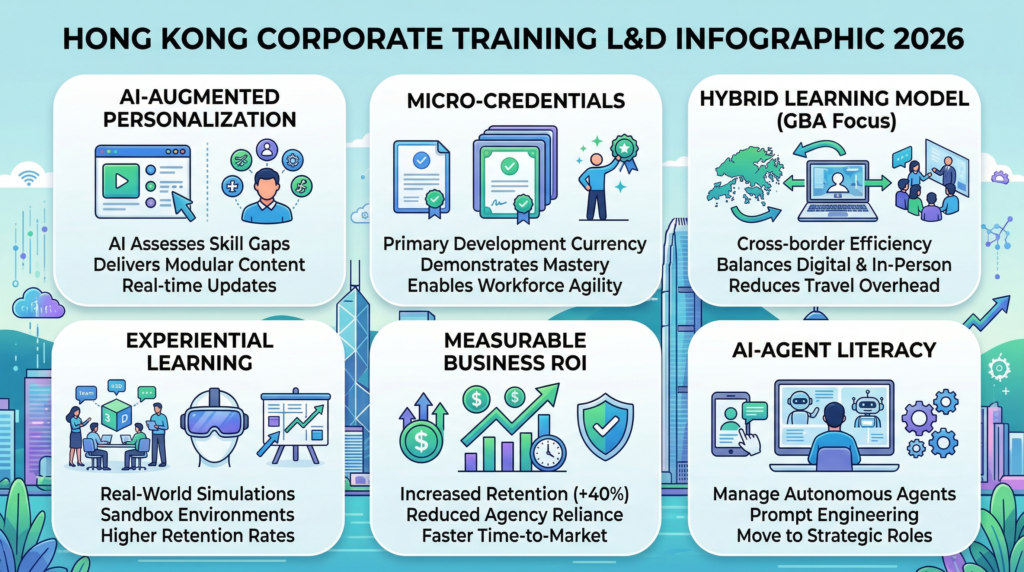
The landscape of corporate training in Hong Kong has transitioned from traditional seminars to high-performance, AI-driven ecosystems. In 2026, the primary objective of corporate training is to secure workforce retention and organizational agility through aggressive upskilling. Marketing leaders now operate in a Greater Bay Area (GBA) economy where technological speed defines market share. This guide provides the technical and strategic frameworks required to design L&D programs that deliver measurable ROI and cultural alignment in the Hong Kong market.
Table of Contents
ToggleWhat are the most effective corporate training programs for Hong Kong businesses in 2026?
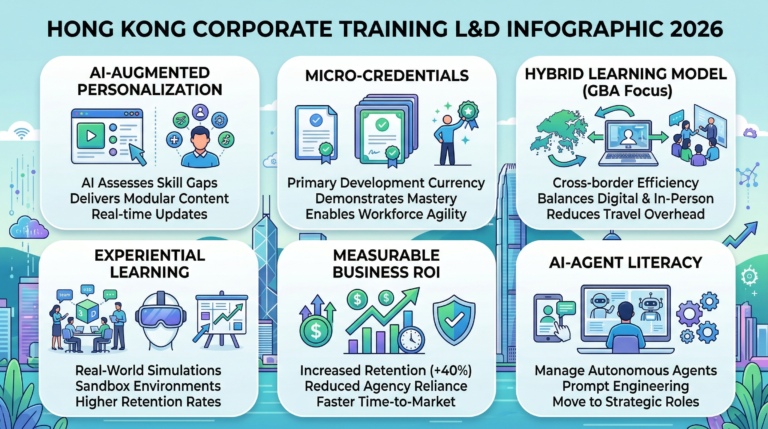
Effective corporate training programs in 2026 prioritize AI-augmented personalized learning pathways and micro-credentials. These programs focus on immediate application in data-driven marketing, cross-functional agility, and specific digital proficiencies tailored to the unique regulatory and technological environment of the Hong Kong and GBA markets.
Why are AI-augmented personalized learning pathways the 2026 standard?
The Hong Kong L&D market identifies AI-augmented personalized learning as the leading trend for 2026. This model utilizes machine learning algorithms to assess individual employee skill gaps and deliver modular content in real-time. In marketing departments, this means a junior strategist receives automated modules on predictive analytics while a senior leader focuses on algorithmic governance. This personalization ensures that training time directly translates to operational output, eliminating the inefficiency of one-size-fits-all workshops.
What role do micro-credentials play in professional development?
Micro-credentials serve as the primary currency for professional development in Hong Kong. These bite-sized, verified certifications allow employees to demonstrate mastery of specific tools, such as advanced social media marketing strategies or CRM automation. For businesses, micro-credentials facilitate workforce agility, allowing leaders to reassign staff based on proven skill sets rather than static job titles. This modular approach to education supports a culture of continuous improvement, which is a core value at Social Stand.
How does experiential learning outperform traditional seminars?
Experiential learning, involving real-world simulations and collaborative problem-solving, produces higher retention rates than passive seminars. In the Hong Kong financial and marketing sectors, experiential programs often utilize sandbox environments where teams practice incident response or campaign optimization. These simulations build muscle memory for high-pressure scenarios, ensuring that marketing teams can pivot strategies during volatile market shifts without performance degradation.
How do I choose between virtual, in-person, and hybrid training models for my team?
Choosing the optimal training model requires evaluating team location, technical complexity, and required engagement levels. In 2026, the hybrid training model holds a high efficiency rating for cross-border teams in the Greater Bay Area, balancing digital accessibility with the essential networking and cultural nuances of in-person interaction.
When is the hybrid training model the most efficient choice?
The hybrid model is the default for multinational corporations operating across Hong Kong and mainland China. This model utilizes virtual platforms for technical knowledge transfer and in-person sessions for collaborative strategy and leadership development. For GBA-based teams, the hybrid model reduces travel overhead while maintaining the interpersonal trust necessary for high-stakes marketing projects. Efficiency data shows that hybrid models allow for 24/7 access to resources while preserving 20% of time for face-to-face mentorship.
What are the specific advantages of in-person training in Hong Kong?
In-person training remains critical for high-level executive education and soft skill development. Hong Kong’s business culture places a high premium on “Face” and hierarchical relationships, which are best navigated through physical presence. Leadership development programs requiring empathetic management training utilize in-person workshops to read non-verbal cues and foster psychological safety. At Social Stand, we recognize that building impressive brand stories often requires the energetic synergy only found in physical collaboration.
How have virtual platforms evolved for 2026 corporate education?
By 2026, virtual training platforms have moved beyond simple video conferencing to immersive spatial computing environments. These platforms allow marketing teams to visualize data in 3D and participate in global hackathons without leaving their Hong Kong offices. Virtual training is the most cost-effective solution for scaling foundational skills across large workforces, though it requires robust digital infrastructure to ensure participation and prevent digital fatigue.
What is the measurable ROI of professional development for marketing and sales departments?
The ROI of professional development is measured through increased retention, reduced agency reliance, and accelerated campaign performance. Statistics show a 40% increase in retention for companies with robust L&D cultures. Marketing departments see direct financial gains by converting training costs into internal capacity and higher conversion rates.
How do you calculate the ROI of training versus agency fees?
Marketing leaders use specific formulas to justify L&D spend by comparing it to the cost of outsourcing. The formula is: (Agency Fee for Service – (Internal Salary + Training Cost)) / Training Cost. If a team undergoes advanced generative AI training for marketing automation, the ability to handle content production internally saves the firm the 15-25% markup typically charged by external vendors. This internal capacity building directly impacts the bottom line while keeping proprietary data within the organization.
What is the correlation between training and employee engagement?
There is a direct positive correlation between comprehensive corporate training and employee engagement. In 2026, Hong Kong professionals prioritize career growth as much as salary. A robust L&D culture reduces turnover by 40%, significantly lowering the costs associated with recruitment and onboarding. Engaged employees who feel the company is investing in their future are more likely to apply a positive attitude toward organizational goals, a philosophy that has guided Social Stand’s growth since its inception.
Which KPIs track the success of marketing training?
Key Performance Indicators for marketing training include Time-to-Market for new campaigns, Lead Conversion Rate improvements, and Digital Maturity Scores. By benchmarking these metrics before and after a training intervention, leaders can quantify the impact of skill acquisition. For example, a team trained in social media marketing strategies through Social Stand’s methodologies will show a measurable increase in ROI and online branding effectiveness within the first two quarters post-training.
How can corporate training address the digital transformation and AI skill gaps in HK?
Corporate training addresses digital gaps by making generative AI training a critical implementation priority. This focuses on marketing automation, data-driven decision-making, and AI-agent literacy. Programs must transition employees from AI-aware to AI-fluent, ensuring they can manage the sophisticated digital tools that define the 2026 Hong Kong economy.
Why is generative AI training a critical priority for marketing?
Generative AI training is essential for automating repetitive tasks and enabling data-driven decision-making. In 2026, marketing leaders use AI to generate real-time consumer insights and personalized ad copy at scale. Without formal training, teams risk falling behind competitors who use these tools to optimize budgets and improve brand awareness. Training ensures that AI is used ethically and effectively, maintaining the quality and simplicity that characterize premium brands.
What is AI-agent literacy as a new core training pillar?
AI-agent literacy involves training employees to manage autonomous digital agents that handle logistics, customer service, and media buying. This is no longer a niche skill but a core requirement for 2026. Corporate training programs now include modules on prompt engineering, agent orchestration, and output validation. This shift allows human employees to move into higher-value strategic roles, focusing on the creative “Impressive stories” that distinguish a brand in a crowded market.
How does training bridge the gap in data-driven decision making?
Data-driven decision-making requires the ability to interpret complex datasets and translate them into actionable marketing strategies. Training programs in Hong Kong now emphasize data storytelling and visualization. By equipping marketers with these skills, businesses can move away from gut-feeling decisions toward a model where every campaign is backed by statistical evidence. This technical proficiency is what allows companies to win prestigious accolades like the ICT Awards and MARKies Awards.
What specific soft skills are essential for leadership development in the Hong Kong market?
Leadership development in Hong Kong requires a focus on empathetic management and psychological safety within high-pressure environments. These core competencies are essential for navigating the city’s unique cultural landscape, which blends Western corporate efficiency with traditional Chinese values regarding hierarchy and interpersonal harmony.
Why is empathetic management a core competency in 2026?
Empathetic management is the primary driver of team cohesion in high-pressure sectors like finance and tech. In 2026, leaders must be able to recognize and address burnout before it leads to turnover. Training in empathy involves active listening, conflict resolution, and the ability to provide constructive feedback that respects the individual’s dignity. This approach fosters a culture of revolution and innovation, as employees feel safe to take risks without fear of retribution.
How do cultural nuances like ‘Face’ affect communication training?
In Hong Kong, the concept of ‘Face’ (Mianzi) is central to professional interactions. Communication training must teach leaders how to offer critiques privately and how to praise publicly to maintain social harmony. Understanding these nuances is vital for multinational corporations (MNCs) where Western management styles might conflict with local expectations. Training programs that incorporate intercultural communication help bridge these gaps, ensuring smooth operations across global agency structures.
What is the role of psychological safety in HK financial sectors?
Psychological safety is the belief that one will not be punished for making a mistake or speaking up. In the high-stakes Hong Kong financial market, this is essential for risk management. Corporate training that promotes psychological safety encourages employees to report errors early, preventing small issues from becoming systemic failures. This transparency is a hallmark of high-quality, professional marketing teams that prioritize long-term brand health over short-term gains.
How do I design a step-by-step workplace training program that employees actually value?
Designing a valuable workplace training program involves a structured approach: assessing skill gaps, selecting the right delivery model, and integrating real-world application. Programs must offer clear career progression through micro-credentials and align with the personal professional goals of the workforce to ensure high participation and engagement.
Step 1: How do I perform a 2026-ready skills gap analysis?
A modern skills gap analysis uses data from performance reviews and project outcomes to identify specific weaknesses. Instead of asking what employees want to learn, leaders should analyze what skills the current market demands—specifically AI-agent management and cross-platform social strategy. This ensures the training is relevant and immediately applicable to the company’s mission of improving ROI through digital excellence.
Step 2: How do I select the right mix of learning modules?
The selection process should prioritize a mix of technical hard skills and psychology-driven management training. For a marketing team, this might include a module on the latest social media algorithms followed by a workshop on collaborative creativity. By balancing these areas, the program develops well-rounded professionals who can handle both the technical and human aspects of the job, mirroring the energetic and passionate team environment at Social Stand.
Step 3: How do I ensure long-term retention of training?
Retention is ensured through post-training support and the application of new skills in live projects. Leaders should implement “Lunch and Learn” sessions where employees share how they applied their training to solve a specific business problem. This social learning reinforces the material and builds a community of practice within the organization. Continuous education is not a one-time event but a lifestyle of constant revolution and improvement.
What are the local Hong Kong regulations and subsidies for corporate education?
Hong Kong provides significant support for corporate education through the Continuing Education Fund (CEF) and other government subsidies. Additionally, corporate training now plays a critical role in meeting ESG (Environmental, Social, and Governance) social reporting requirements, making it a regulatory necessity for listed companies.
How does the Continuing Education Fund (CEF) support professional development?
The Continuing Education Fund (CEF) remains highly relevant in 2026, providing subsidy support for eligible local professional development courses. Businesses can leverage these funds to offset the costs of upskilling their workforce in areas like digital marketing, financial analysis, and language proficiency. Utilizing CEF-approved courses ensures that the training meets government quality standards while maximizing the company’s L&D budget.
What are the ESG social reporting requirements for HK companies?
Under 2026 regulations, listed companies in Hong Kong must report on their investments in human capital as part of their ESG disclosures. This includes data on average training hours per employee and the diversity of leadership development programs. Robust corporate training initiatives satisfy the “Social” pillar of ESG, demonstrating a commitment to employee welfare and long-term sustainability. This transparency builds brand trust with investors and consumers alike.
How do local HK training providers compare to global platforms?
While global platforms like Coursera and LinkedIn Learning offer vast libraries of content, local Hong Kong training providers offer essential cultural and regulatory context. Local providers understand the nuances of the HK and GBA markets, such as specific social media behaviors and local labor laws. For marketing leaders, a combination of global technical training and local strategic insight—such as that provided by agencies with deep 4As experience like Social Stand—is the most effective way to build a world-class workforce.
By focusing on these strategic pillars, Hong Kong marketing leaders can build resilient, AI-fluent teams ready to dominate the 2026 business landscape. The investment in corporate training is no longer an optional expense; it is the fundamental driver of retention, agility, and brand success.