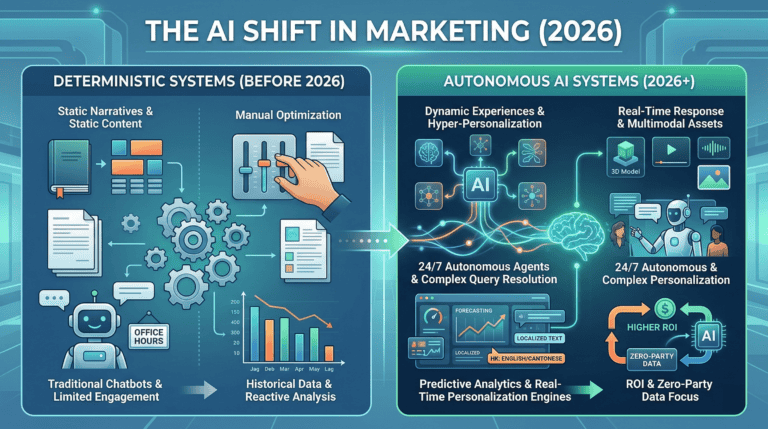
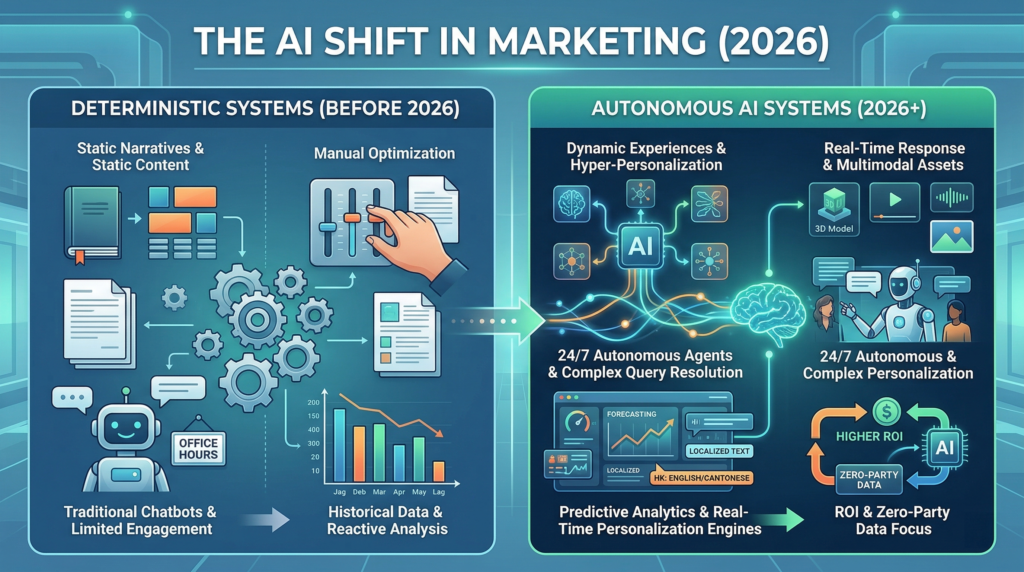
The marketing landscape in 2026 is defined by a shift from deterministic strategies to autonomous, probabilistic systems. As digital marketing professionals with global agency exposure, the Social Stand team recognizes that impressive stories that make great brands are no longer just static narratives; they are dynamic experiences powered by high-fidelity technology. This guide provides a technical and strategic framework for navigating the current AI ecosystem in Hong Kong and beyond, focusing on online branding, ROI, and the revolution of customer engagement.
Table of Contents
ToggleWhat is artificial intelligence (AI) and how does it empower modern marketers?
Artificial intelligence (AI) empowers modern marketers by providing hyper-personalization, predictive analytics, and 24/7 autonomous customer interaction. It transforms raw data into actionable insights, allowing brands to execute complex social media marketing strategies that improve online branding and ROI through real-time asset optimization and consumer behavior modeling.
How does AI redefine business value in 2026?
In the current 2026 landscape, AI functions as a core utility for scaling human creativity and analytical precision. The primary business value of AI lies in its ability to deliver hyper-personalization at a scale previously impossible. By analyzing trillions of data points across social platforms, AI systems identify micro-segments of audiences, delivering bespoke messaging that resonates with individual psychological drivers. Predictive analytics further enhances this value by forecasting consumer trends before they manifest in search volume, allowing brands to secure first-mover advantages in competitive markets like Hong Kong.
Autonomous customer interaction represents the third pillar of modern AI value. Unlike traditional chatbots, 2026 AI agents manage 24/7 engagement across multi-channel environments, resolving complex queries and facilitating conversions without human oversight. This capability ensures that brand awareness is built continuously, mirroring Social Stand’s mission to help businesses enjoy the growth offered by social media. AI integration into marketing stacks reduces operational overhead while increasing the velocity of campaign deployment and optimization.
How do generative AI, machine learning, and deep learning differ for business use?
Generative AI creates novel outputs such as text, photorealistic images, and 3D models from prompts. Machine learning utilizes historical consumer data for predictive lead scoring and churn analysis. Deep learning leverages the transformer architecture, a foundational neural network structure, to enable large-scale language and visual understanding for complex marketing tasks.
What are the specific outputs of Generative AI for marketers?
Generative AI has evolved beyond simple text generation to produce high-fidelity multimodal assets. Marketers now utilize these systems to generate photorealistic images for social media campaigns, intricate 3D models for virtual product launches, and interactive software prototypes for user experience testing. This technology allows for the rapid iteration of creative concepts, ensuring that brand stories are visual, immersive, and memorable. Social Stand utilizes these tools to maintain a ‘Revolution’ mindset, pushing the boundaries of what is possible in digital storytelling.
How is Machine Learning applied to consumer data?
Machine learning (ML) remains the analytical engine for marketing departments. Its primary use case in 2026 involves predictive lead scoring, where algorithms evaluate the probability of a prospect converting based on historical interaction patterns. ML also excels at churn analysis, identifying ‘at-risk’ customers by detecting subtle shifts in engagement frequency or sentiment. By deploying ML models, businesses can allocate resources more efficiently, focusing high-touch human interventions on the most valuable segments while automating retention efforts for others.
Why is the Transformer Architecture significant?
The Transformer architecture is the technical breakthrough that underpins modern AI’s ability to process sequence-based data. Its significance lies in the ‘attention’ mechanism, which allows the model to weigh the importance of different parts of an input signal differently. In marketing, this translates to a deeper understanding of context in consumer language and visual trends. Whether it is a Large Language Model (LLM) or a visual transformer, this architecture enables the high-level reasoning required for sophisticated brand-building and customer journey mapping.
What are the most effective AI tools for content creation and marketing in 2026?
The most effective AI tools in 2026 include Gemini 3 for native multimodal reasoning and Lyria 3 for high-fidelity music generation. Nano Banana 2 enables secure on-device processing for mobile applications, while specialized generative systems produce photorealistic imagery and interactive software prototypes to streamline the creative workflow for global brands.
How does Gemini 3 facilitate multimodal content strategy?
Gemini 3 represents the pinnacle of multimodal AI integration. It possesses native reasoning capabilities across video, audio, and code, allowing marketers to generate real-time assets from a single prompt. For a social media agency, Gemini 3 enables the simultaneous creation of a video script, the edited video file, the background score, and the underlying tracking code for the campaign. This tool drastically reduces the time between strategy and execution, ensuring that brands remain agile in the fast-paced Hong Kong market.
What is the role of Lyria 3 in audio branding?
Audio is a critical component of brand identity, and Lyria 3 provides the technology to automate high-fidelity soundscape generation. Marketers use Lyria 3 to create bespoke music for social media advertisements that align perfectly with the visual pacing and emotional tone of the content. This level of customization ensures that every touchpoint in a digital campaign is unique and tailored to the brand’s specific sonic identity, enhancing recall and engagement rates.
Why use Nano Banana 2 for mobile marketing?
For privacy-sensitive applications and low-latency requirements, Nano Banana 2 is the preferred deployment model. It is designed for on-device processing, meaning that AI computations happen locally on the user’s smartphone rather than in the cloud. This is particularly valuable for mobile marketing in sectors like finance or healthcare, where data security is paramount. Nano Banana 2 allows for real-time personalization of mobile app interfaces and notifications without compromising user privacy, a key consideration for maintaining ‘Quality’ and ‘Simplicity’ in digital experiences.
How does Agentic AI automate complex marketing workflows and campaign management?
Agentic AI automates multi-step marketing workflows by executing autonomous sequences without manual intervention. These systems function as digital employees, handling tasks from audience segmentation to budget reallocation across platforms like Facebook and LinkedIn, ensuring that marketing campaigns achieve optimal ROI through continuous, independent optimization.
What defines the autonomous execution of campaigns?
Agentic AI differs from standard automation because it possesses the ability to make decisions based on goal-oriented prompts. When assigned a campaign objective—such as increasing brand awareness in the APAC region—the agent decomposes the goal into sub-tasks. It identifies target demographics, generates creative variants using integrated generative models, sets up A/B tests, and adjusts bidding strategies in real-time. This autonomous execution removes the bottleneck of manual approvals for every tactical change, allowing human marketers to focus on high-level strategy and ‘Fun’ creative concepts.
How does Agentic AI handle multi-step workflows?
In 2026, marketing workflows often involve dozens of interconnected steps. An AI agent can monitor a brand’s social media mentions, categorize sentiment, and trigger specific responses. If it detects a surge in positive sentiment for a particular product, it can automatically increase the ad spend for that product, notify the sales team, and generate a celebratory social post. This end-to-end management ensures that no opportunity for growth is missed, providing the ‘Positive Attitude’ and ‘Revolutionary’ results that modern businesses demand.
What are the current AI regulations and ethical standards for marketers in Hong Kong?
AI compliance in Hong Kong is governed primarily by the Personal Data (Privacy) Ordinance (PDPO), which is mandatory for any AI system involving personal data. The ‘Artificial Intelligence: Model Personal Data Protection Framework’ (2024) and ‘Guidance on the Ethical Development and Use of AI’ (2021) serve as non-binding ethical recommendations for businesses.
How does the PDPO apply to AI data scraping and decision-making?
The Personal Data (Privacy) Ordinance (PDPO) does not contain specific statutory provisions for ‘automated decision-making’ transparency or ‘ethical data scraping’ in the way the EU’s GDPR does. Instead, these issues are governed by the general Data Protection Principles (DPPs). Marketers must ensure that the collection of personal data for AI training is necessary, fair, and accompanied by proper notification to the data subjects. While the 2024 Model Framework is non-binding, Social Stand adheres to these standards to ensure quality and trust in every campaign.
What are the compliance requirements for HK SMEs?
For Hong Kong SMEs, compliance with the PDPO is mandatory if personal data is being processed by an AI system. This includes data used for training generative models or data analyzed by predictive engines. Businesses should conduct Data Privacy Impact Assessments (DPIA) to identify potential risks. Since the 2024 and 2021 frameworks are recommendations, they provide a roadmap for ethical AI use—such as ensuring human-in-the-loop oversight and bias mitigation—but they do not carry the force of law. However, failing to follow DPPs can lead to enforcement notices and reputational damage.
How can AI improve customer engagement and ROI for Hong Kong businesses?
AI improves customer engagement and ROI by leveraging real-time personalization engines and Small Language Models (SLMs) trained on niche industry data. By utilizing zero-party data directly from consumers, Hong Kong businesses can create highly relevant experiences that drive conversion and long-term brand loyalty in a data-secure environment.
What is the advantage of Small Language Models (SLMs) in Asia?
Small Language Models (SLMs) are becoming the preferred choice for niche industry marketing in Asia. Unlike massive global models, SLMs are fine-tuned on specific regional datasets, such as Hong Kong’s unique blend of English and Cantonese business terminology. These models require less computational power and can be deployed more cost-effectively, providing SMEs with high-performance AI that understands local cultural nuances. This leads to higher engagement rates as the AI-generated content feels more authentic to the local audience.
How do Real-time Personalization Engines drive ROI?
Real-time personalization engines analyze user behavior as it happens—clicks, dwell time, and navigation paths. In 2026, these engines use this data to instantly modify website layouts, product recommendations, and promotional offers. For a brand looking to improve ROI, this means the ‘Simplicity’ of the user journey is maximized, reducing friction and increasing the likelihood of purchase. Social Stand integrates these engines into social media strategies to ensure that every ad impression is optimized for the highest possible return.
Why is Zero-party Data critical for AI training?
With the decline of third-party cookies, zero-party data—information that customers intentionally and proactively share with a brand—has become the gold standard for AI training. By using quizzes, preference centers, and interactive social content, marketers collect high-intent data that AI models use to build accurate consumer profiles. This data is more reliable than inferred data and ensures that the brand’s hyper-personalization efforts are based on direct consumer input, leading to more ethical and effective marketing.
What is the difference between Narrow AI and Artificial General Intelligence (AGI) for enterprises?
Narrow AI is designed for specific, limited tasks like image recognition or sentiment analysis. Artificial General Intelligence (AGI) refers to hypothetical systems with human-level reasoning across all domains. Enterprises currently use general-purpose world models, such as DeepMind Genie 3, to simulate interactive 3D environments for training and prototyping.
How is Narrow AI used in daily marketing operations?
Most AI tools used today fall under the category of Narrow AI. These systems are highly specialized. For example, an AI tool might be exceptional at optimizing Google Ads bids but incapable of writing a creative brand manifesto. Marketers deploy a suite of Narrow AI tools to handle specific parts of the marketing funnel, from lead generation to post-purchase support. This modular approach allows for ‘Quality’ control and precise measurement of ROI for each specific function.
What is the role of DeepMind Genie 3 as a World Model?
DeepMind Genie 3 represents the frontier of general-purpose world models. It is designed to generate interactive, physically consistent 3D environments from text or image prompts. While not AGI, it demonstrates the ability to understand the physical laws of a digital space. For enterprises, this is used for gaming prototyping, robotics simulation, and creating immersive marketing experiences where users can interact with products in a simulated world. It allows brands to build ‘Revolutionary’ virtual showrooms that are generated dynamically based on user preferences.
How should marketers prepare for the future of AI-driven search and SEO?
Marketers should prepare for AI-driven search by focusing on semantic relevance and brand authority rather than keyword density. As search engines transition to generative models that provide direct answers, optimizing for AI agents requires structured data, high-quality zero-party insights, and content that provides unique ‘Information Gain’ for the user.
How does AI-driven search change SEO strategy?
In 2026, SEO is no longer about ranking in a list of blue links; it is about being the source of truth for an AI’s generated response. Search engines now utilize multimodal models to answer queries directly on the results page. Marketers must ensure their content is easily ingestible by these models by using clear schema markup and technical SEO best practices. The goal is to become the ‘Entity’ that the AI recognizes as the most authoritative source for a specific topic, such as social media marketing strategies in Hong Kong.
Why is brand authority more important than ever?
As AI agents become the primary interface through which consumers discover information, brand authority serves as a trust signal for the algorithm. AI models are trained to prioritize information from reputable, awarded sources. Maintaining a record of industry recognition—such as W3 Awards, ICT Awards, and MARKies Awards—provides the external validation that AI systems use to weigh the credibility of a brand’s content. Social Stand’s history of excellence ensures that our clients’ brand stories are prioritized in an AI-dominated search environment.
What is the ‘Information Gain’ requirement?
AI-driven search engines now prioritize content that offers ‘Information Gain’—new, unique information that isn’t already present in the model’s training data. To stay ahead, marketers must move away from generic, ‘me-too’ content. Producing original research, proprietary data insights, and unique brand perspectives is the only way to ensure that content is not filtered out as redundant by AI crawlers. This aligns with the ‘Positive Attitude’ of innovation, where brands lead the conversation rather than simply repeating it.
By integrating these strategic AI pillars, marketers in 2026 can build more resilient, efficient, and creative brands. Whether through the autonomous execution of campaigns with Agentic AI or the deployment of secure on-device models like Nano Banana 2, the future of marketing lies in the synergy between human strategy and machine intelligence. Join our newsletter to stay updated on the latest social media and AI trends as we continue to revolutionize the digital marketing landscape.